
It’s a warm summer’s evening and we stand outside the Hilltop Classroom at Belwin Conservancy in Afton, overlooking rolling hills covered in prairie that glow golden in the sun. Gnarled oaks dot the landscape and there’s a sense of peace and tranquility. A deer nibbles, a hawk flies, insects quietly buzz about their business. The beauty of nature envelops us and invites our group to stay for a while.
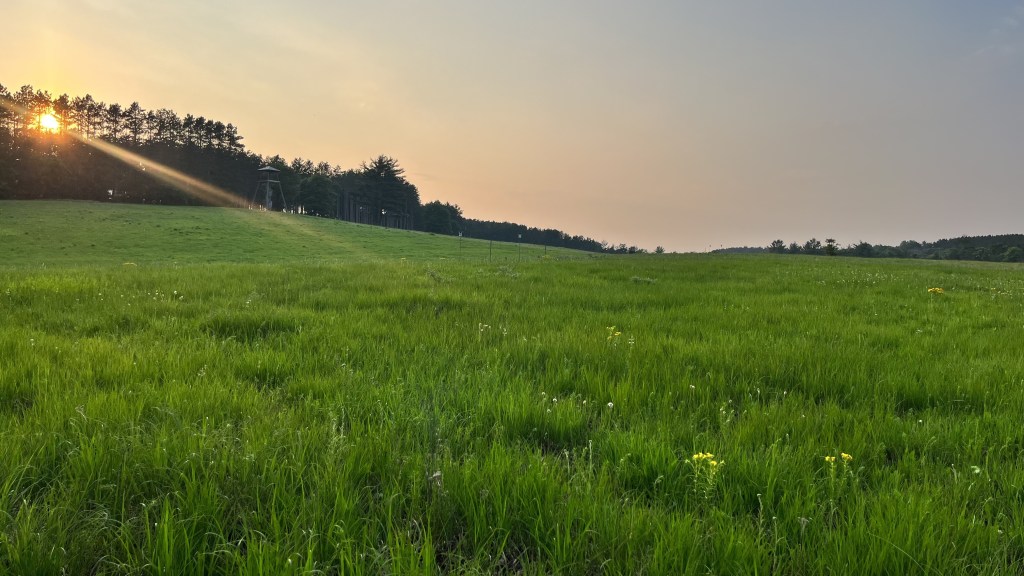
Though the St. Croix River has a well-known history as a conduit for timber and logs during the 1800s, pre-colonial vegetation in the lower St. Croix region was actually comprised of oak savanna and prairie, similar to the restored environment you see today at Belwin. Maple-basswood forests grew further north in Chisago and southern Pine Counties, and the pine forests that fed the lumberjack era began even further north in Pine County where the Chengwatana State Forest and St. Croix State Park are located today.
“Oaks don’t like to grow in their own shade,” explains Tara Kelly, a landscape restoration specialist with the Washington Conservation District. “They depend on disturbance from wind, storms and fire to maintain openings that give them space to grow. In the absence of disturbance, maples, ironwood, and basswood in the understory begin to grow and the forests in our area will naturally transition from oak openings to maple-basswood woods.”
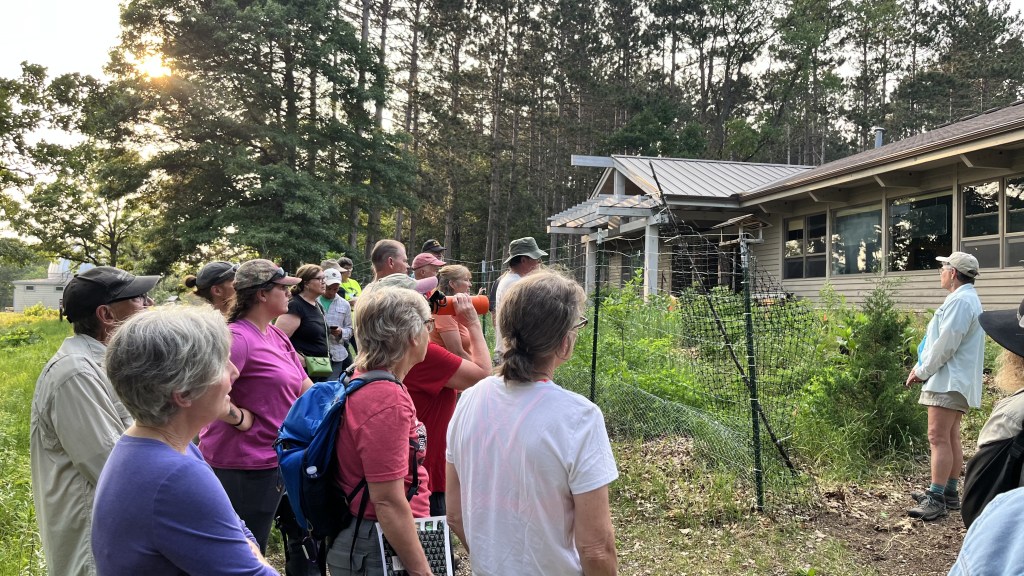
On this evening in June, our group is gathered at Belwin to learn about managing woodlands for resiliency, and one of the key take-aways is that a love of forests requires landowners to actively engage with and care for their forests and woodlands.
Oak savanna exists in the transitional zone between forest and prairie and is one example of an ecosystem that co-evolved with human influence over thousands of years. Dakota and Ojibwe people used fire as a tool to maintain open areas in order to attract large game animals such as bison and elk. Today, you can see landscape managers using fire and grazing as restoration strategies at Belwin, Afton State Park, Lake Elmo Regional Park, and other locations.
Some of the biggest challenges facing local woodland landowners today include invasive species, changing rainfall patterns, and overgrown pine plantations.
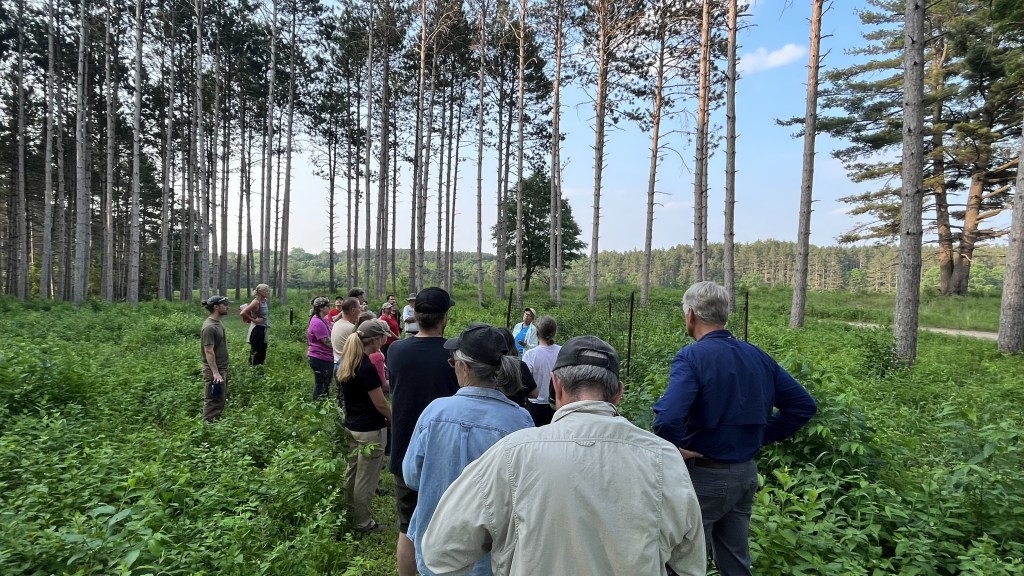
Lynette Anderson, an interpretive naturalist and restoration specialist at Belwin, leads us to a pine plantation on the property that was planted in the 1950s. “The trees are too close together and need to be thinned,” she explains. “And, ecologically speaking, red pines grow in northern Minnesota, not here.” She points to a small fenced-in area beneath the pines where they are working to establish native understory plants. It is one of several “eco patches” they are tending.
Kelly explains that we’re getting more rain annually, but spread out into a few big storms that are more likely to cause flooding. The result is that many trees in our area have become stressed by drought conditions. Tree species such as red maple, bur oak, white oak, red oak, hazelnut, and serviceberry are well suited for these changing conditions, while species such as balsam fir, black spruce, white spruce, paper birch, and quaking aspen are expected to decrease over the next 80 years.
As for invasive species, Kelly and Anderson recommend using a multi-pronged approach that includes early detection and rapid response; manual techniques such as pulling, mowing, and dead-heading (cutting off flower heads before they go to seed); herbicide applications in the early spring and fall; and fire and grazing on a semi-annual basis.

Belwin’s 1500 acres of restored prairie and woodlands offer landowners a tantalizing goal to strive towards, but Anderson acknowledges that landscape restoration can be discouraging at times. “Let it be a joyful thing and not a burdensome thing,” she encourages our group. “Focus on a small area and make that beautiful. Be flexible and willing to roll with the punches and prepare to be resilient yourself.”

 East Metro Water
Beautiful
Thanks
LikeLike