
When Maggie Rice and her husband Griff Bartzen moved to Scandia in 2021, they were excited to find a slice of small-town living, less than an hour from Minneapolis and St. Paul. “We like to say that it’s rural, but not remote,” says Rice with a laugh.
Though the couple is originally from Minnesota and Wisconsin, they spent their first several years after college living in New York City. “After a while, I got burned-out on city life and made a bit of a career shift,” Rice explains. She took an apprenticeship at a dairy goat farm in Vermont, fell in love with farming and animal husbandry, and then started looking for a chunk of farmland somewhere back in the Midwest.
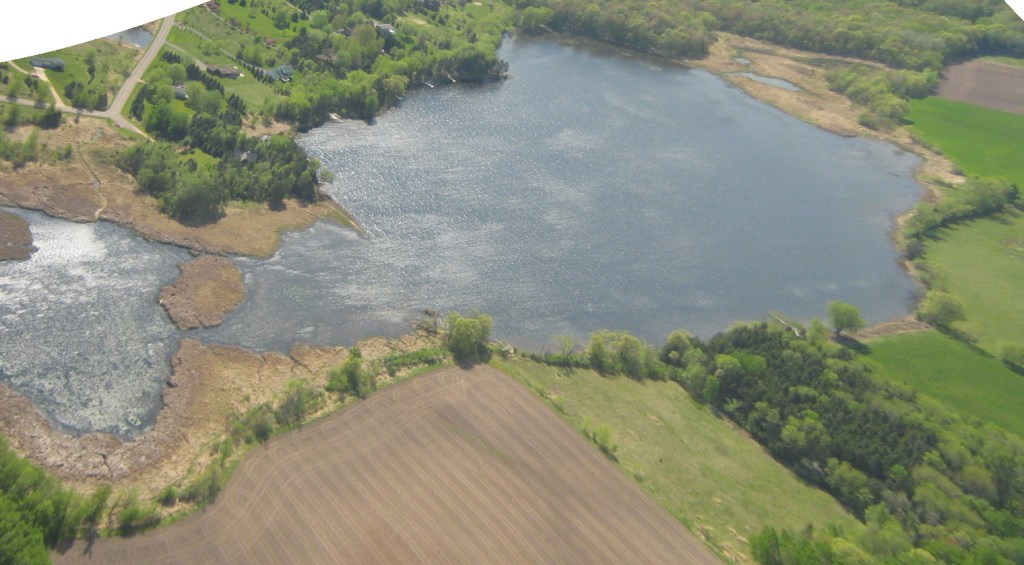
Eventually, Bartzen and Rice found a 20-acre parcel on Hay Lake, which had been in row crops and hay fields for decades. After transforming some of the land into pasture to graze goats and raise chickens, Rice also connected with staff from UMN Extension, Washington Conservation District, and the Carnelian-Marine-St. Croix Watershed District (CMSCWD) to discuss options for their land.

With cost-share grant support from the CMSCWD, Rice and Bartzen were able to convert six acres of cropland to native prairie in 2022 and establish a 100-foot native buffer along Hay Lake. This year, Rice is excited to watch the prairie continue to grow and eager to dive deeper into farming on their land.
Though Rice and Bartzen are relatively new to town, their prairie and buffer planting is just one of many clean water projects completed by the Carnelian-Marine-St. Croix Watershed District and local landowners in recent years to improve water quality in Hay Lake.

Hay is a small, shallow lake located near the border of Scandia and Marine on St. Croix that is hydrologically connected to Sand Lake and the St. Croix River during periods of high water. In 2010, the lake was added to Minnesota’s impaired waters list due to excess phosphorus, which was causing abundant algal growth during the summer. The watershed district developed a multi-lake plan to improve water quality and began working to identify high priority locations for reducing phosphorus runoff through projects that convert turf lawns and cropland to native prairie.

In 2014, Mark and Sarah Porubkansky converted 1.45 acres of turf to prairie, which reduced phosphorus loading to Hay Lake by 0.8lbs per year. In 2015, Lonnie Holmgren worked with the Watershed District to restore native habitat along 300ft of Hay Lake shoreline that was previously planted with hay. Then, in 2018, Dan Lee established a one-acre prairie buffer along the west side of Hay Lake that keeps 3.9lbs per year of phosphorus out of the lake. The most recent project on Maggie Rice’s farm has reduced phosphorus loading by 2.5 pounds per year.
Unlike corn and soybeans, the deep roots of prairie plants are well-suited for stabilizing hills and shorelines and also make the plants drought-resistant. In addition, perennial crops like hay provide year-round cover for the soil, which helps to prevent erosion. It is estimated that one pound of phosphorus in a lake is capable of growing up to 500 pounds of algae. Taken as a whole, the Porubkansky, Holmgren, Lee, and Rice planting projects are now preventing 3600 pounds of algae growth in Hay Lake, every summer!
Water monitoring data has shown a steady improvement in Hay Lake’s water quality over the past ten years as a result of planting projects completed on the land in the surrounding watershed. In 2022, the Minnesota Pollution Control Agency officially “de-listed” Hay Lake, meaning it is no longer considered impaired.

“I hope that water quality will continue to improve,” says Maggie Rice. “It will be cool to see how it changes even more in the future.” For more information about Hay Lake and the Carnelian-Marine-St. Croix Watershed District, visit www.cmscwd.org. For assistance planting prairies in Washington County, contact the Washington Conservation District at www.mnwcd.org.

 East Metro Water