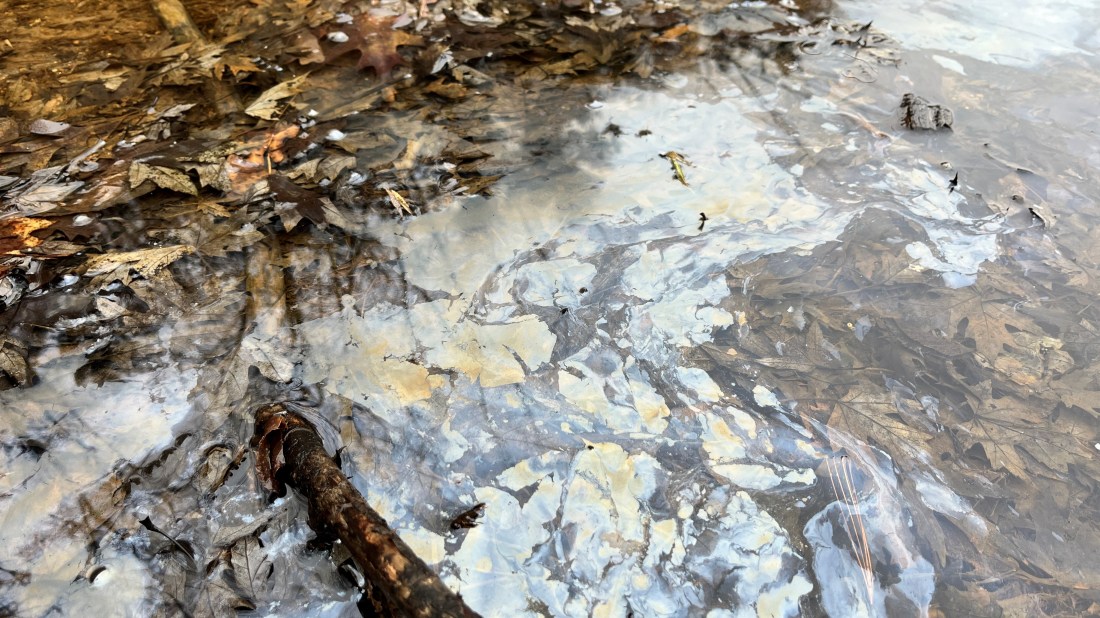
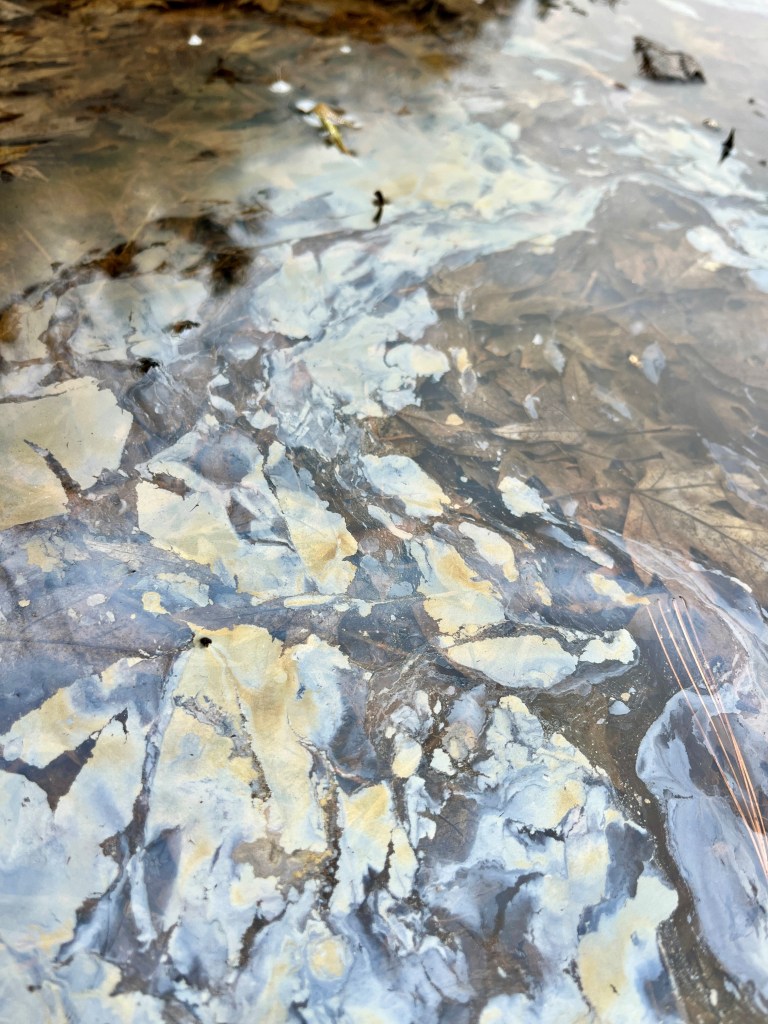
It was New Year’s Eve on the semi-frozen St. Croix River and my son and I were engaged in our favorite activity – poking along and looking for cool things. While he sat on a log carving a stick into a spear, the epitome of a teenage boy, I wandered along a spring-fed stream and gazed into the water. The surface swirled with iridescent colors like a rainbow had spilled out of the sky and into the water. I poked a stick into the center of the sheen and it broke like a pane of glass.
Rainbows in water are often a sign of spilled oil. You’ve probably noticed them in parking lots when it rains or perhaps even in your own driveway. A rainbow flowing across the pavement is a cue to check your car for leaks. It goes without saying, as well, that oil spills can cause major ecological damage. If you’re seeing rainbows in a nearby wetland or creek, however, it’s not necessarily caused by pollution.
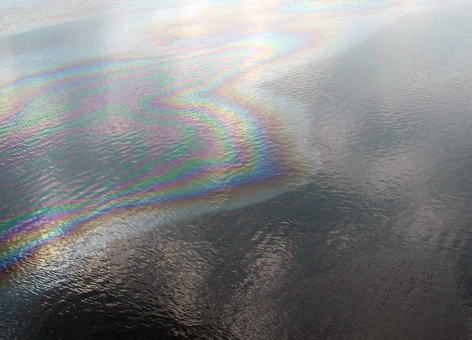
There are several natural processes that can create rainbow sheens on water that look very similar to spilled oil. In stagnant water and wetlands, these sheens are often caused by natural decomposition of plants, animals, insects, and other organic matter. This doesn’t mean the water is dangerous to touch but is a good reminder of why it’s not safe to drink untreated water when you’re out hiking, camping or canoeing.
Natural sheens can also be caused by iron-decomposing bacteria that feed off of iron deposits in the soil and rocks near the water. In this example, the rainbow effect is not caused by natural oils, but rather by tiny platelets that coalesce on the water’s surface and create a thin reflective film, sort of like a mirror. These sheens are common in groundwater-fed streams and wetlands, like the one my son and I explored last week. If there is an exceptionally high iron content in the water, it will sometimes turn orange as it oxidizes or even create a nasty looking orange goop.
In the 4th and 5th century BCE, Europeans learned how to collect “bog iron” deposits from wetlands and streams to make metal tools. By heating the iron-rich rock and soil in a furnace, it is possible to separate the iron from the rest of the materials. The product, known as “spongy iron bloom,” is then hammered to make usable wrought iron.
Today, many of us are familiar with the tangy flavor of iron-rich water, which is common in wells at campgrounds and up north. Iron-rich groundwater will also cause orange staining in plumbing fixtures, similar to the orange hue seen in wetlands and streams.
The easiest way to distinguish between natural rainbows and those caused by spilled oil or gasoline is to take a rock or a stick and poke it into the center of the sheen. Natural sheens will break apart like glass and rarely form back together. Oil spills, on the other hand, are harder to disrupt and quickly come back together when disturbed. In addition, petroleum spills usually have a characteristic smell and will usually have an obvious source, such as a stormwater pipe.
If you do find an oil or hazardous material spill, it’s important to report it to your city’s illicit discharge (IDDE) hotline so that they can investigate the source and initiate clean-up. Large spills from accidents, pipeline breaks, or other sources should be reported to the Minnesota Duty Officer (651-649-5451 or 1-800-422-0798) to coordinate a state and local response.
If, on the other hand, you find a rainbow caused by natural decomposition or iron-bacteria, feel free to stay and play for a while. I enjoy making animated sound effects like “zap” or “boom” while breaking apart the sheens, but you’re welcome to choose your own sounds!

 East Metro Water