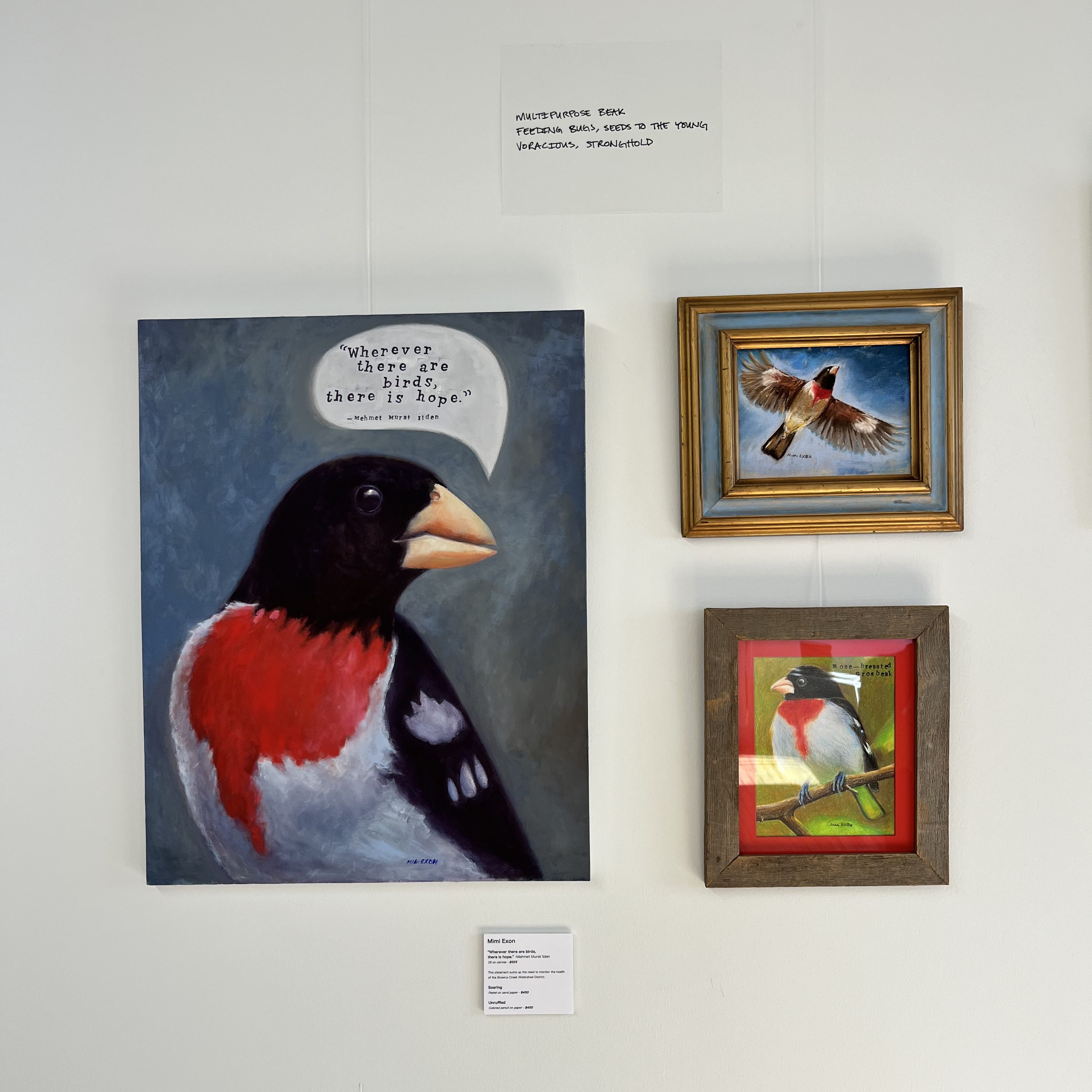
Near the corner of Main St. S and Nelson St. E in downtown Stillwater, you’ll find a set of green doors and a stairway leading up to A House Unbuilt’s art, water, and ecology community space. Inside the studio, a rose-breasted grosbeak greets you with a quote from Turkish playwright Mehmet Murat Ildan, “Wherever there are birds, there is hope.” On the opposite wall, a caddisfly prepares to go to battle against erosion in a comic book kingdom. In the corner, a collection of lures and lines are arranged around a set of vintage posters that read “Charlie’s hand-tied flies.”
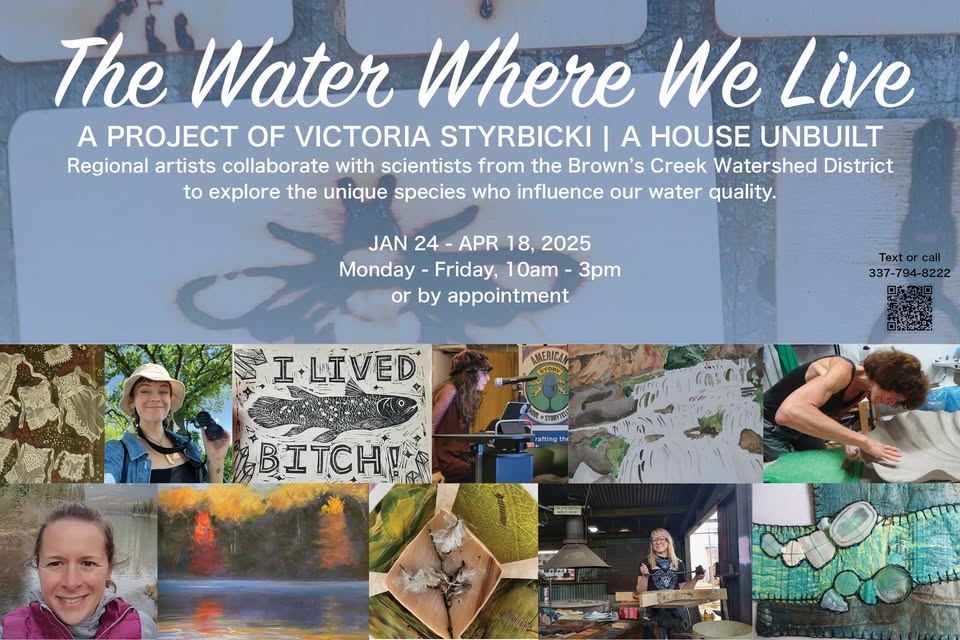
This is The Water Where We Live, a unique collaborative exhibition between 12 regional artists and the Brown’s Creek Watershed District, curated and displayed by Victoria Bradford Styrbicki. Participating artists include Jennifer Anderson, Amy Clark, Mimi Exon, Deanna Grigus, Thersa Harsma, Brighton McCormick, Megan Miller, Jenny Elaine, Robin Stumbo, Amy Walsh, Jill Waterhouse, and Wookiye Win.
Styrbicki grew up in Louisiana at the other end of the Mississippi River, where the weather is hot and most people’s jobs have something to do with fishing or oil. “When I first moved to Minnesota, I wanted to get to know the ecosystem in my new watershed,” she says. “Despite the differences in weather, there are a lot of similarities between Minnesota and Louisiana. I realized that there are opportunities for top of the river and bottom of the river connections and conversation.”

When Styrbicki met with Karen Kill, administrator for the Brown’s Creek Watershed District, she says that Kill was practically bursting with stories about Brown’s Creek and the organisms that live here. “We decided to put out a call for ecologically-focused local artists to create pieces inspired by nature in the watershed,” she explains. One month later, there were 12 artists committed to the project and The Water Where We Live began to take shape.
The overarching goal of the project is to use art as a teaching tool to inspire people and help them understand how they are connected and what they can do to make a difference. “The art is supposed to communicate with us, not just be something to look at,” Styrbicki says. “The question is, ‘how can an artist expand the work that the watershed district does and tell the story in a more creative way?’”

Some of the pieces in the exhibit focus on specific species of interest, such as the Blanding’s turtle or star-nosed mole. Others highlight the impacts of environmental stressors like housing development or energy production.
When I talked with Styrbicki during a visit last week, she was busy weaving a fishing net from plant fibers for an upcoming exhibit in St. Charles, Louisiana. “Oil production has had such an impact on life in Louisiana,” she says, “But Minnesota and the St. Croix watershed are also impacted by oil pipelines and silica sand mining for natural gas production. So, again, there are opportunities for top of river and bottom of river connections and conversations.”
As we talked, she offered me a flight of water from three local communities to sample and discuss. Two came from groundwater aquifers, the remnants of a long-gone glacier. The third originated in the Mississippi River, which provides drinking water for more than 20 million people and 50 cities between Minnesota and the Gulf of Mexico. I took a sip and wondered, “How’s the water where we live?”
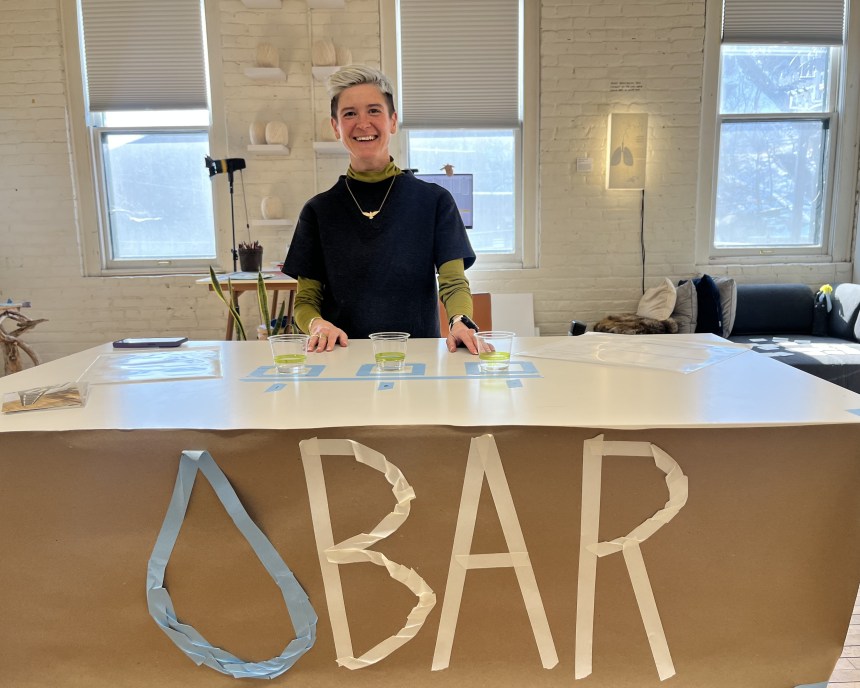
The Water Where We Live is open for viewing Mondays through Fridays from 10am – 3pm or by appointment at A House Unbuilt’s Art & Water Space (321 Main Street S – second floor). There will also be a reception on Thursday, March 6 from 4-7pm that is free and open to the public. Stop by to meet the artists, have a drink at the “Water Bar,” and learn from environmental professionals at Brown’s Creek Watershed District and EOR. I will also be speaking at the event.

 East Metro Water