
White Bear is a lake with a storied past. At 2438 acres, it is the second largest lake in the Twin Cities metro, and its history features a legendary fight with a giant bear, steamships, gangsters, famous authors, legal battles, and even an amusement park. Recently, efforts led by the Washington Conservation District have focused on improving habitat and reducing stormwater runoff from small communities located along the southeast shore of the lake.

In a summary of Ramsey County History published in 1965, Nancy Woolworth writes that, “Ancestors of the Medewakanton (Spirit Lake People) band of the Santee Sioux scoured these forests for deer, ate fish caught in the lake, dropped berries into their canoes, collected maple sap from trees on Manitou Island, picked cranberries from the marshes of White Bear Beach, picked blueberries near Hugo and gathered wild rice in the lakes around Centerville.”


For centuries, the Dakota [Sioux] people called the lake “Mahto-bde,” which translates to “Bears Lake.” This Dakota name is also the basis for the modern city named Mahtomedi. Sometime in the late 1800s, however, a legend emerged about an Ojibwe hunter who fought a great white bear on Manitou Island in order to save a Dakota maiden. Both the bear and the man were said to die in the fight, and the story grew increasingly popular after it was published in Mark Twain’s 1883 book, Life on the Mississippi.
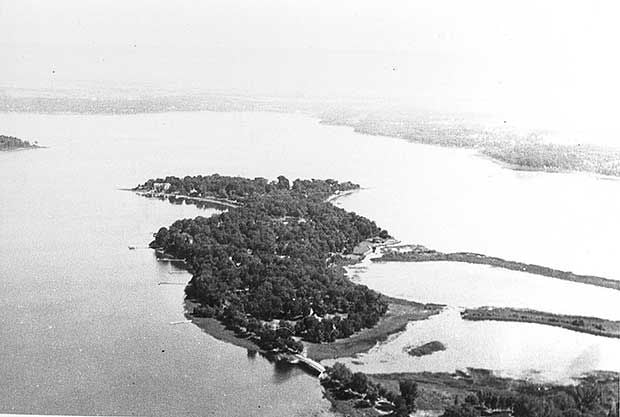
During the late 1800s, White Bear Lake became a popular destination for visitors from St. Paul, who arrived via a quick 20-minute train ride and then crossed the lake by steamship to reach resorts on White Bear and Bald Eagle Lakes. In 1900, Wildwood Amusement Park opened in Mahtomedi, and later, during the 1920s, F. Scott Fitzgerald spent time at a lake cottage in Dellwood white writing The Great Gatsby. During the Prohibition Era, the notorious gangsters Ma Barker and Al Capone even found refuge hiding near the lake.

Though the communities surrounding White Bear are now solidly suburban, the lake still retains much of its beauty and charm. It is a deep lake (83ft at its maximum) with relatively low levels of phosphorus and algae, and maintains an overall grade of “B” for lake health in spite of the presence of two invasive species – zebra mussels and Eurasian watermilfoil (Minnesota DNR).
For the past 13 years, many of the conversations about White Bear have focused on lake levels and the potential negative impacts caused by groundwater being pumped to provide drinking water and irrigation for surrounding communities. In 2012, the White Bear Lake Restoration Association and the White Bear Lake Homeowners Association sued the Minnesota DNR after record low lake levels left docks and beaches stranded far from the water’s edge. Though the water has returned to a more normal level, legal battles have continued for more than a decade and have dramatically changed the way nearby cities think about future growth and development.

For the past three years, Washington Conservation District has been working with small cities on the southeast side of White Bear Lake – Mahtomedi, Birchwood, and Willernie – to improve bird and pollinator habitat and reduce stormwater runoff.
One recent example is a native shoreline planting along Lost Lake in Mahtomedi, which is located in Wildwood Park. The project features a mix of native trees and shrubs, aquatic plants, and upland native plants, as well as improved lake access for fishing and recreation. Nearby at OH Anderson Elementary, the WCD has also worked with teachers and students to enhance an existing prairie at the school and plant a pollinator garden along the wooded edge of the prairie. In Birchwood Village, the city is moving forward with improvements at Tighe Schmitz Park, designed to reduce seasonal flooding, upgrade infrastructure, and reduce stormwater runoff to Hall’s Marsh and White Bear Lake.


Funding for these projects comes from a variety of sources, including Watershed Based Implementation Funds (Clean Water, Land, and Legacy Amendment), the Habitat Enhancement Landscape Program (HELP), and Rice Creek Watershed District’s water quality cost-share program.
In the shadow of a great white bear, a lake’s story continues to unfold. Flowers bloom along the water’s edge and if you listen carefully, some people say you can still hear the spirits of man and bear floating gently on the breeze.

 East Metro Water
Angie is a great storyteller bringing both historical context and current issues to light.
LikeLike