
It is a beautiful November day when we stop out to visit Wendy Stone at Migiziwazison, a small 20-acre oasis in Grant where she and husband Mark Rutkiewicz have lovingly tended the land for three decades. During today’s visit, the couple is excited to begin seeding a new prairie and to share a successful, chemical-free strategy for eradicating invasive round leaf (oriental) bittersweet.
The land here was once part of a larger 240-acre farm that was established in the 1860s. Today, the restored farmhouse and barn are surrounded by a patchwork of micro habitats – wet meadow, restored prairie, old pine plantation, and woods.


“Every time we cut down a diseased pine, oriental bittersweet comes up in its place,” Wendy explains. “The birds spread the berries, leaving a huge seed bed below each tree. We’ve learned that a very hot fire will kill off the bittersweet, but a standard prairie burn won’t get hot enough.”
We arrive at a large, rectangular, open patch of land where she and Mark have assembled a collection of tools – light rakes, a broad fork, and a walk behind broadcast spreader – as well as several bags of prairie seed. “We spent three years trying to get rid of the bittersweet here before we finally found a solution,” she says. Smiling, she reaches down and unfolds a giant swath of black plastic fabric that is lying on the ground. An enormous face – larger than life – smiles back at us from the cloth. It is an old billboard, previously used to advertise Raising Cane’s Chicken.
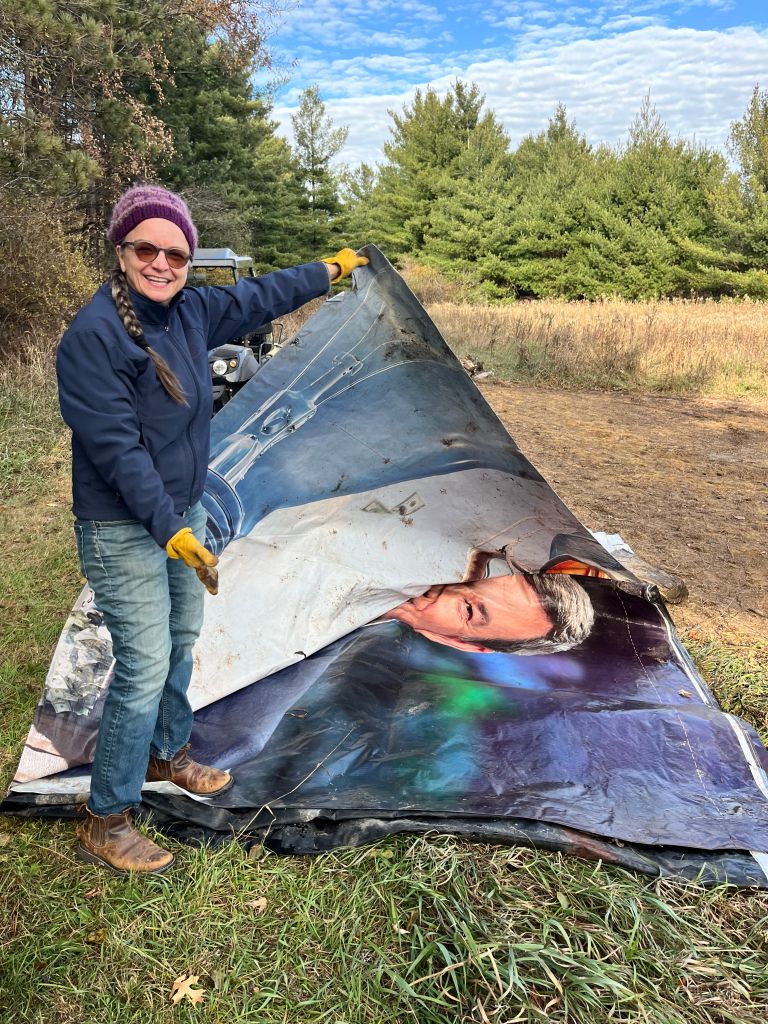
Round leaf bittersweet is an invasive woody vine, native to China, Korea, and Japan, that was introduced to North America in the mid-1860s as an ornamental shrub. The vines girdle and smother trees and out-compete our indigenous American bittersweet, making it a formidable foe in our Minnesota woodlands. In an attempt to eradicate bittersweet from their soon-to-be prairie, Wendy and Mark had tried killing it off with a low-heat fire, digging up the roots, and smothering it with a large blue tarp. All efforts proved unsuccessful.
Finally, Wendy found a website online where you can order old billboards to reuse. “It was cheaper to buy two billboards than one large blue tarp,” she says, “and the fabric is longer-lasting and does a better job of blocking out sunlight.” Once the billboards arrived, it was a relatively simple two-step process. First, they laid the billboards out face-down on top of the area they hoped to clear and let them sit for a couple of months. Mid-summer, they lifted the fabric and gave the weeds a couple of weeks to begin re-growing. Then, they mowed down the weeds and put the billboards back down again. Two months later when they pulled up the fabric again, the earth beneath was smooth and ready to plant, without any signs of bittersweet, thistle, or other invasive species.
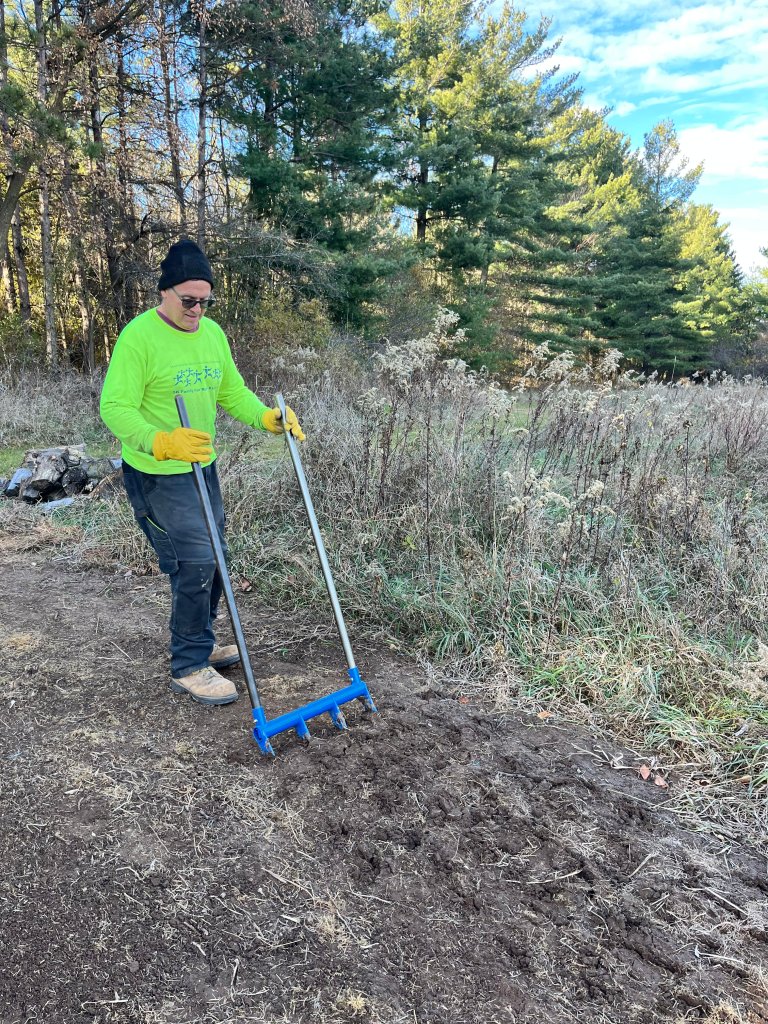
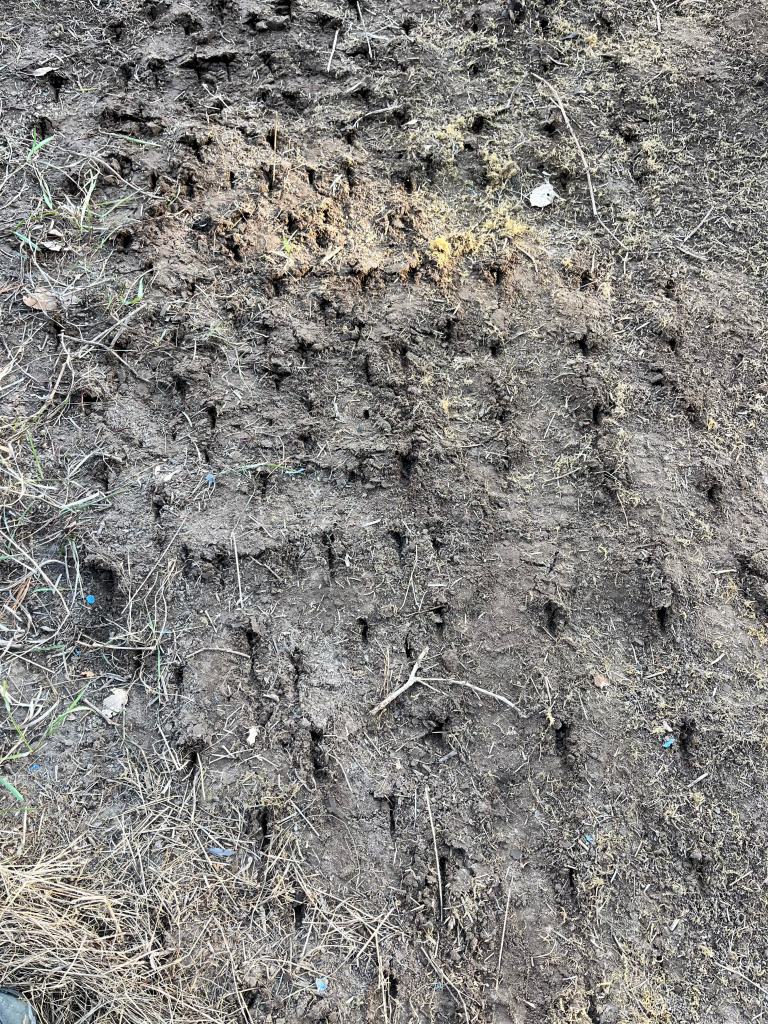
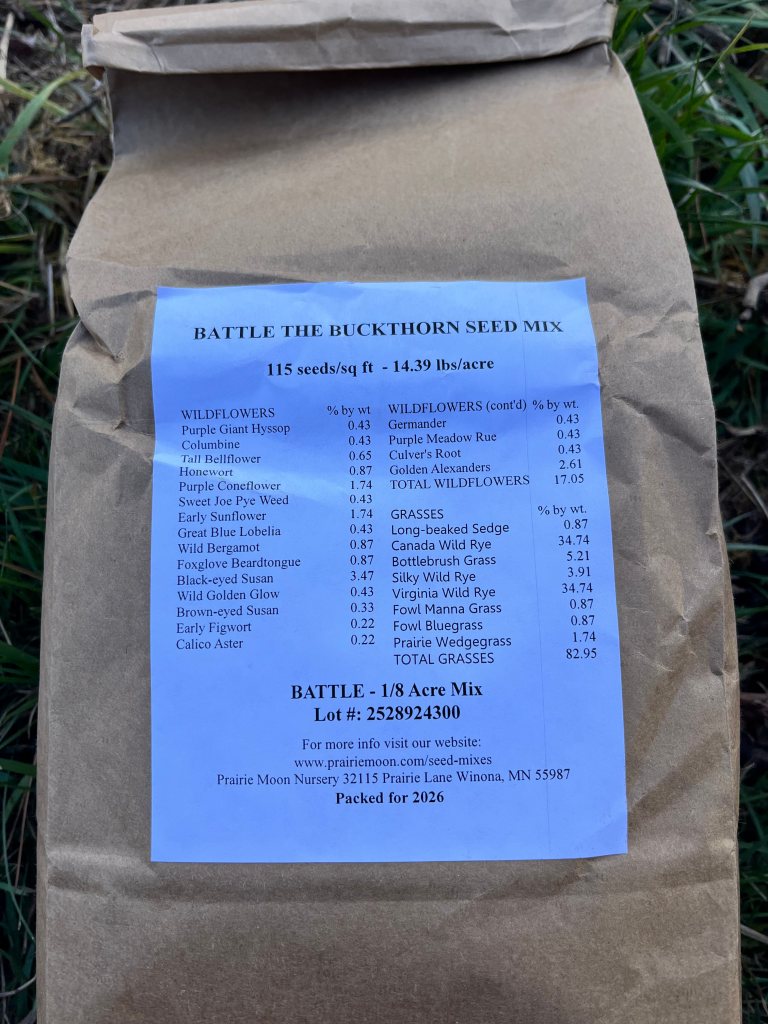
As we talk, Mark uses the broad fork to begin lightly loosening the soil to prepare it for planting. “It’s important not to disturb the soil structure too much,” Wendy cautions. “We just want a light touch to help the seeds reach the soil.” She pulls out three bags of seed mix from Prairie Moon Nursery, labeled “Deer-Resistant”, “Battle the Buckthorn,” and “Classic Prairie,” and uses the broadcast spreader to begin laying seed. At the very end, she walks across the whole area, tapping the ground lightly with a rake to help the seeds find a home in the soil. “I’m not raking it. I’m bouncing it,” she cautions. “This is where I see most people messing up when they plant.”
A few minutes later, the seeds are spread and the work is done. The only task left is to rest for the winter and let Mother Nature take it from here.


To learn more about round leaf bittersweet and managing invasive species in Washington County, visit www.mnwcd.org/invasive-plants.
To learn about Migiziwazison, a nonprofit foundation with Indigenous teachings, focused on land restoration, reclamation, and grassroots efforts to promote a sustainable future, visit migizifoundation.org.

 East Metro Water