
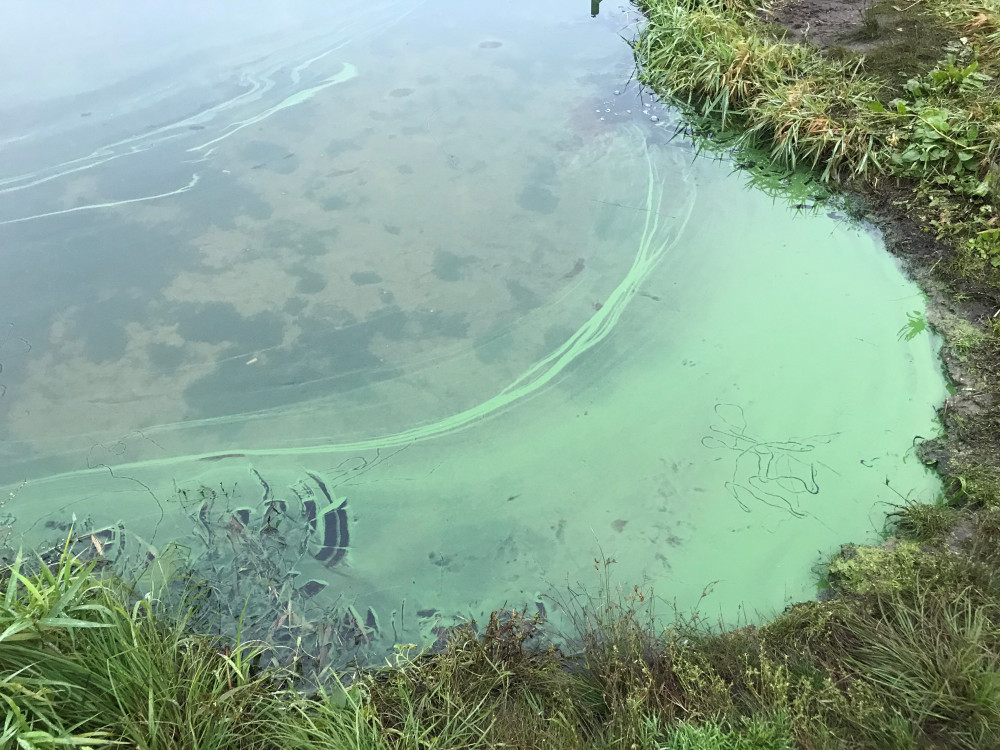
This fall, the Comfort Lake-Forest Lake Watershed District (CLFLWD) will be conducting an alum treatment on Forest Lake to address phosphorus in the lake bottom sediments that contribute to algae growth. This project will be a major milestone for the lake, after more than a decade of research, planning, community engagement, grant-writing, and stormwater management efforts. The goal is to further reduce phosphorus levels in Forest Lake by 527 lbs/yr to prevent harmful algae blooms.
“A lot of lake management actually ends up being phosphorus management,” says John Holz, a limnologist with Solitude Lake Management who has worked with the watershed district on previous alum treatments. “Lakes accumulate phosphorus from their surrounding watersheds for decades. When alum is applied, it draws phosphorus out of the water column and seals sediment on the lake bottom so that the nutrient can no longer feed algae.” Local residents can expect to see clearer water in Forest Lake after the alum treatment, virtually overnight.

Alum (potassium aluminum sulfate) is a nontoxic compound that you may even have in your kitchen cupboard. Used as an additive in pickling and canning, it helps to keep fruits and vegetables crisp and firm. It is the primary ingredient in Maalox – say goodbye to heartburn! – and is also used for drinking water clarification in cities like Minneapolis that get their water from a lake or river. “For lake treatment we use the exact same formulation as for drinking water,” explains Holz. “It is completely safe and doesn’t kill anything. In fact, it doesn’t even kill the algae; it merely binds the phosphorus so that it is no longer available to support algal growth.”
Using a custom, specialized barge, the contractor will deliver alum to the middle basin of Forest Lake in areas that are 15ft or deeper. The alum will be pumped into the water as a liquid formulation that forms a white, cotton-ball looking substance called flock. The flock then sinks to the bottom of the lake and forms a one-inch thick layer on the bottom. The alum flock attracts phosphorus in the water and has numerous binding sites where the phosphorus can attach. Once it has sunk to the lake bottom, it compresses and creates a seal that prevents phosphorus in the sediment from re-circulating. On average, a typical alum treatment is capable of binding 70-90% of the internal phosphorus load in a lake (the phosphorus that is already in the water).

Recreation on Forest Lake will not be restricted during the alum treatment, however boaters will be asked to give the barge space as it navigates around the lake to avoid application disruptions. Some additional plant growth is expected to occur after the alum treatment, due to the clearer water. Aquatic plants are an important part of a healthy lake ecosystem and provide habitat for fish and wildlife.
Over the past decade, CLFLWD has completed dozens of lake-improvement projects for Forest Lake. Some of the biggest include a stormwater reuse project and alum treatment on Shields Lake, an iron-enhanced sand filter along County Rd 50, a wetland treatment basin on 3rd Lake, and working with the City of Forest Lake to implement targeted, enhanced street sweeping. Community residents have also completed numerous small planting projects through the watershed district’s cost-share grant program.

CLFLWD will be holding info sessions on Saturday, June 24, 10am-noon (CLFLWD office, 44 Lake St. South, Suite A, Forest Lake) and Thursday, June 29, 5-7pm (Lakeside Memorial Park, 95 East Broadway Avenue, Forest Lake). Stop by anytime during the two-hour sessions to ask questions and learn more about the alum treatment and watershed district projects. There will be 30-minute presentations on June 24 at 11am and at June 29 at 6pm.
You can also track project updates at www.clflwd.org/projects/forest-lake-alum-treatment, or stop by and visit with watershed district staff at Forest Lake Arts in the Park, every Tuesday in June, July and August.

 East Metro Water
Did you know that an important factor in aquaculture / water health is maintaining a consistent diatom bloom? Managing ammonia and nitrate concentrations in finfish, shrimp and prawn farms can be a major headache.lake algae control
LikeLike