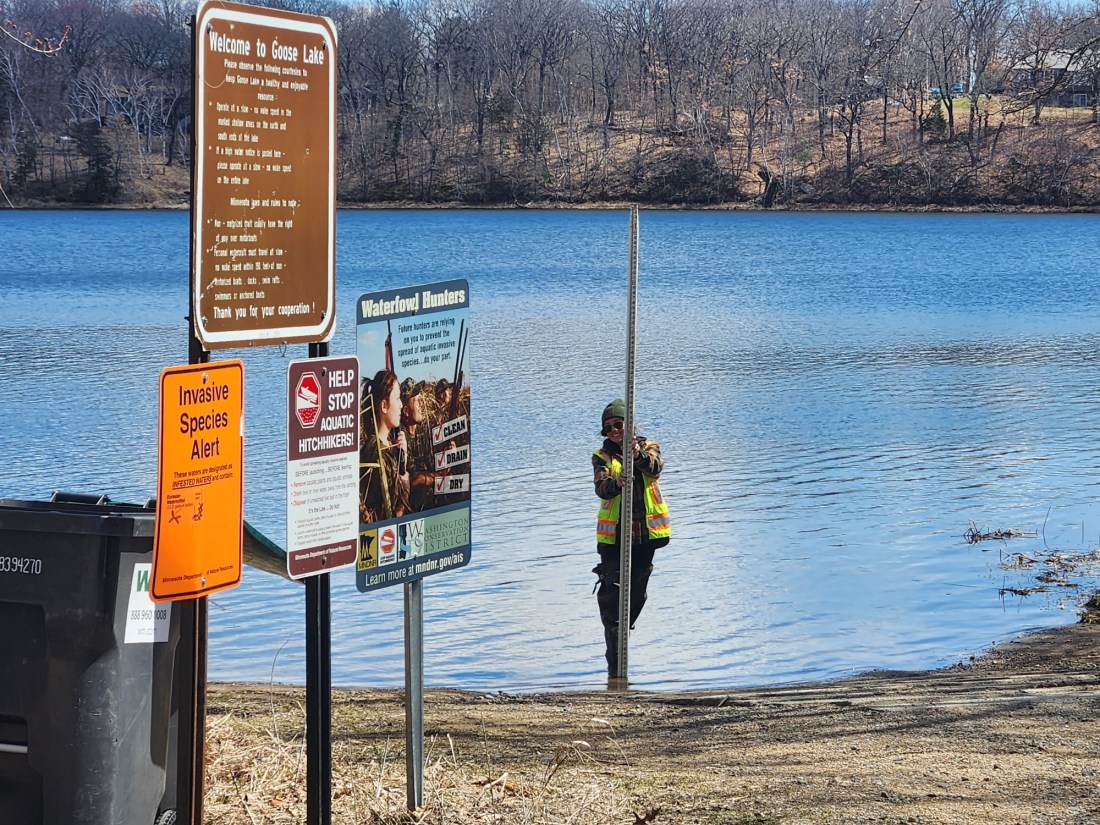
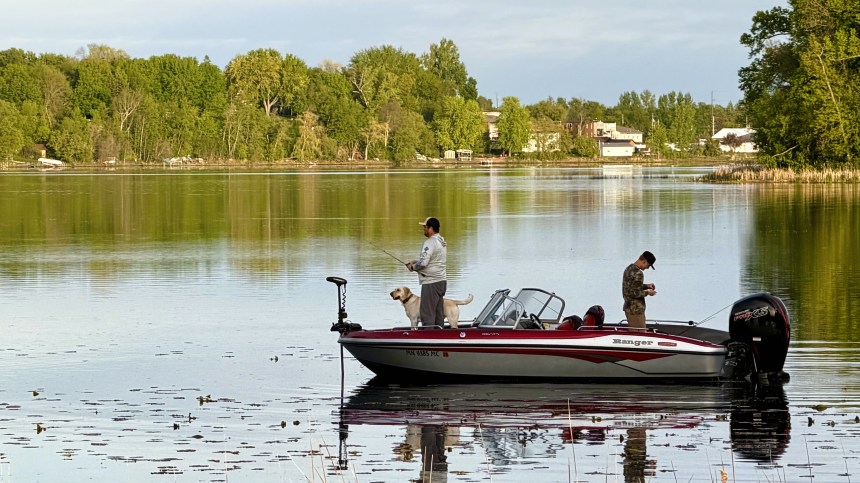
On an early morning at the lake, there are a few things you might expect to see – mist rising off the water, ducks flying out of the reeds, a fishing boat hovering off the tip of a peninsula, and a watercraft inspector waiting patiently near the launch.
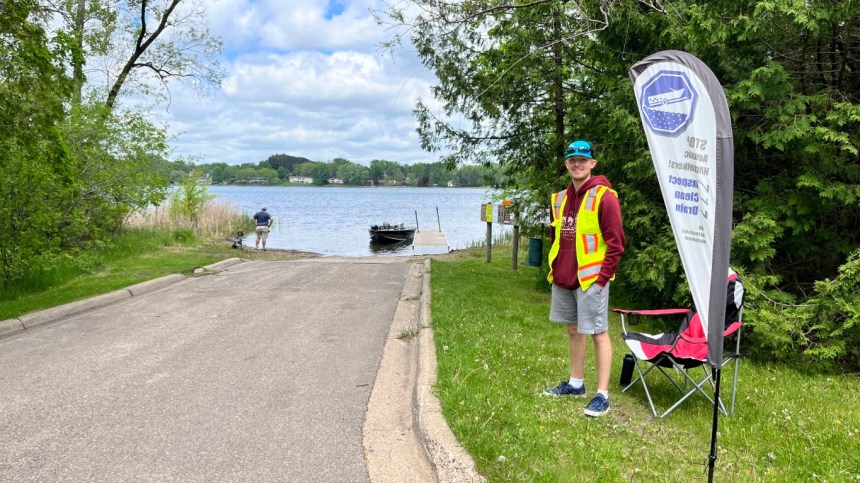
“I always tell people, if I’m at work, I’m not on the lake,” says Matt Oldenburg-Downing, coordinator for Washington Conservation District’s aquatic invasive species (AIS) program. “We make sure WCD inspectors start their shifts before 8:30am or after 3pm so they spend the majority of their time outside of normal working hours. We also try to get extra coverage during weekends and holidays. In fact, if you want to see something wild, go look at the line of cars waiting to get onto Bald Eagle Lake at 5am.”
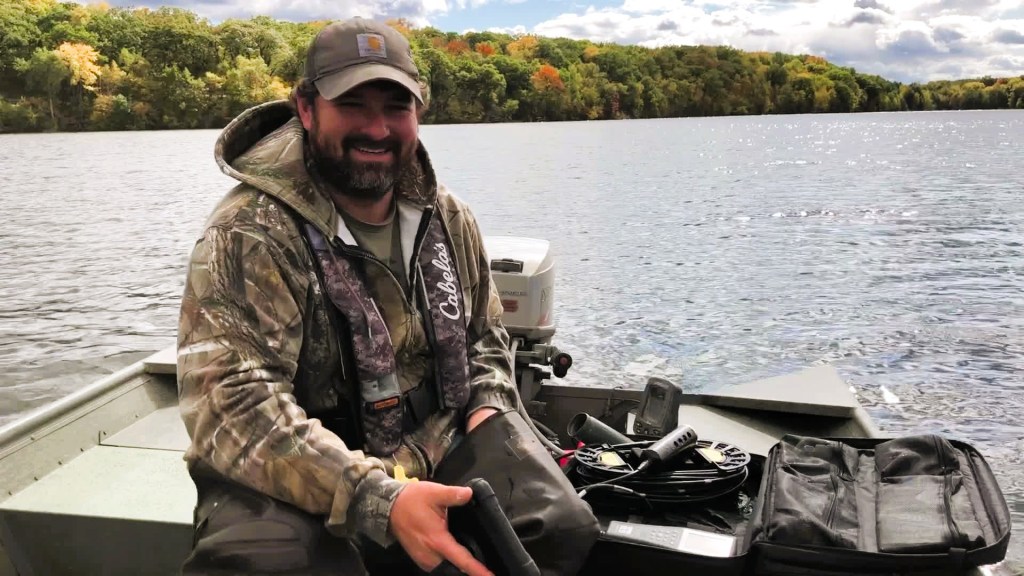
The WCD started its watercraft inspections program in 2015, after the Minnesota State Legislature began distributing funds to counties to tackle invasive species such as zebra mussels, starry stonewort, spiny waterflea, and Eurasian watermilfoil. WCD inspectors are trained and authorized through the Minnesota Department of Natural Resources (DNR) and patrol 18 public accesses in Washington and Ramsey Counties, helping to ensure that boaters clean and drain their equipment and don’t have mud, plants, or mussels attached. State funding covers about half of the program costs, while contributions from Carnelian-Marine-St. Croix and Valley Branch Watershed Districts, City of Scandia, and Bald Eagle, Big Marine, Demontreville-Olson, and Square lake associations cover the rest.

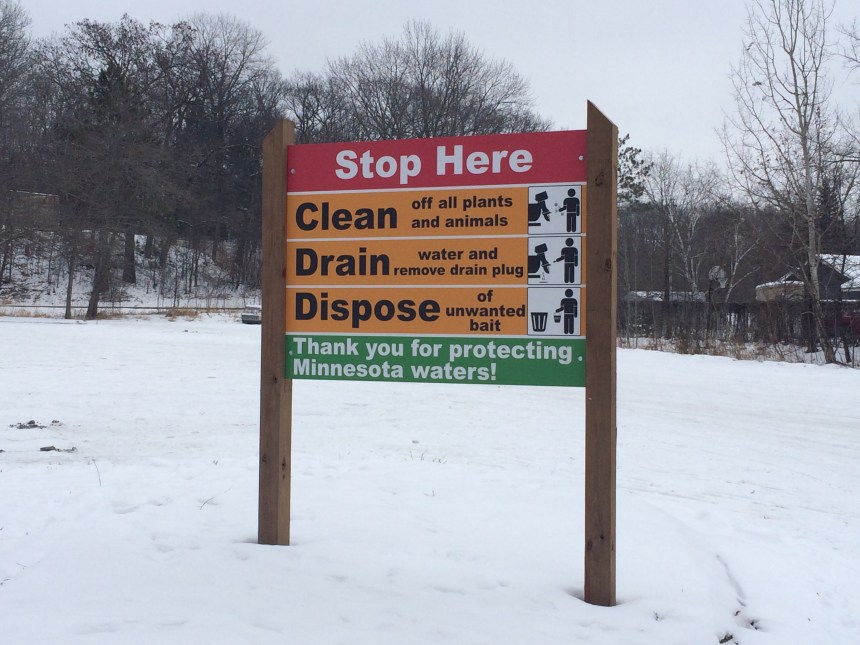
“Our watercraft inspections program is our biggest public outreach tool,” Oldenburg-Downing continues, “but we’ve also done a lot of other things over the years to make sure people know about AIS.” Examples include signs, pavement marking, bait disposal stations, and boat-cleaning tools at public launches, as well as special mailings to shoreline landowners, an e-newsletter for local lake associations, and informative videos for the general public.
In recent years, inspection stats show that 95% of incoming watercraft arriving at launches in Washington County have been in compliance with state laws and 98% have been free of plants, invasive animals, mud, and water. That’s a major improvement since 2015, when only 86% of watercraft were in compliance. Even so, there have been several new AIS infestations over the past decade, which suggests boats and launches may not be the only vectors for transmission.
The risk for new AIS infestations goes up in the early fall when lakeshore landowners begin hiring contractors to help them remove their boats and docks. It’s also a challenge in the early summer when shoreline landowners buy used lifts and docks. Most of these sales happen directly between consumers, and people don’t always realize they need to take extra steps before using their new purchases.
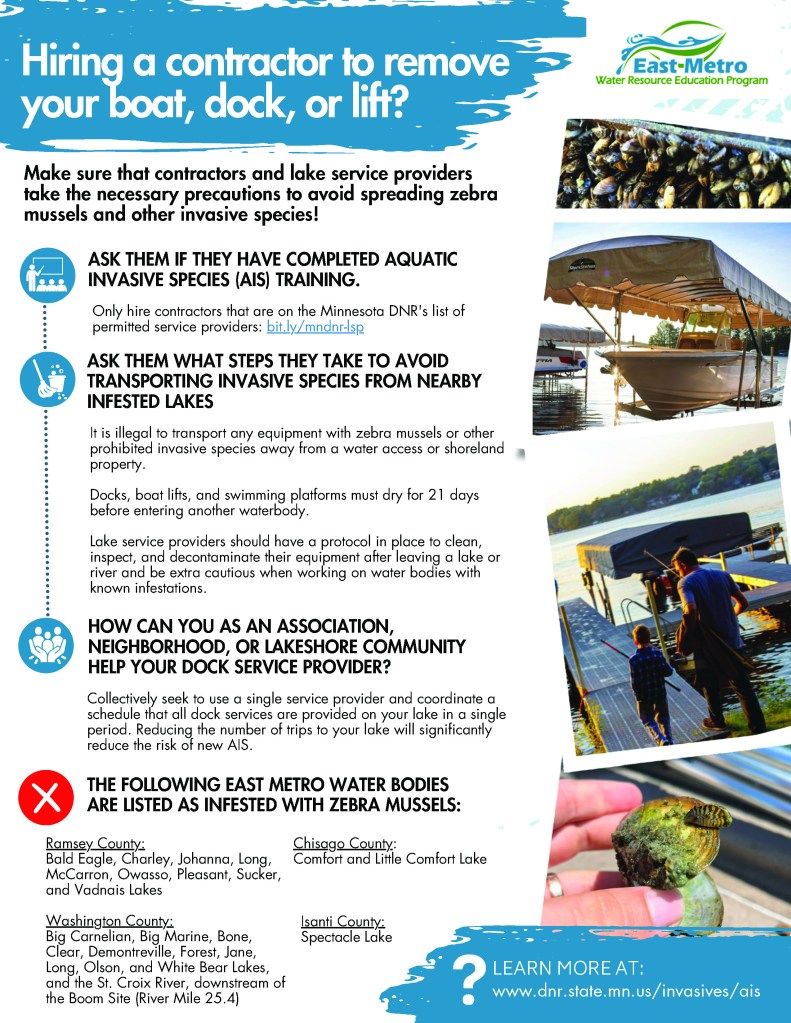
“In Minnesota we have a law that requires docks, lifts, boats, and rafts to clean, sit, and dry out of the water for 21 days before they can go to another lake,” explains April Rust, Minnesota DNR’s AIS Training Coordinator. “This has been a law since 2013, but not everyone knows about it.” Lake service providers are also required to get a permit and participate in regular training through the DNR to learn best practices for preventing the spread of AIS.
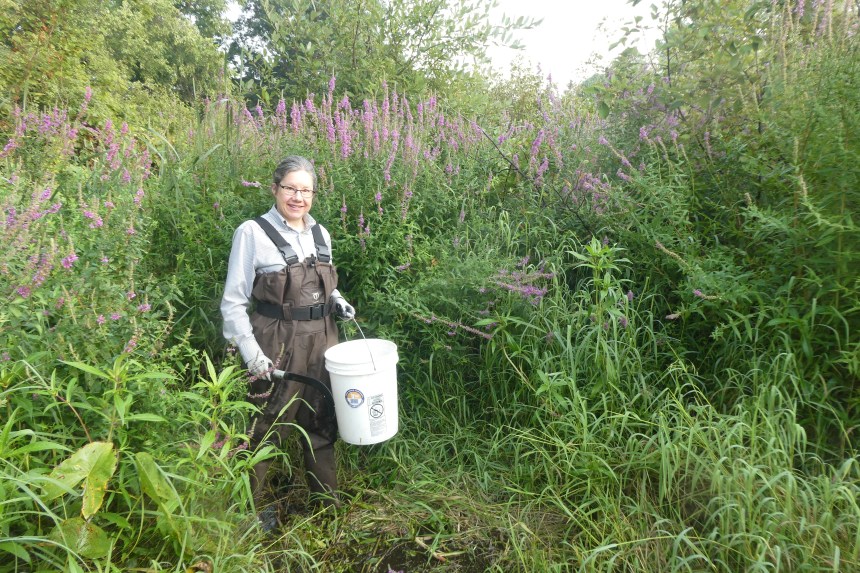
Volunteers also provide vital support for many AIS prevention and management efforts. For example, Wild Rivers Conservancy launched a volunteer program in 2022 to raise and release Galerucella beetles to control invasive purple loosestrife plants. Though state grant funding for Wild Rivers’ program ended last year, many local volunteers and lake associations have continued raising the beetles on their own.
Another example is Starry Trek, a one-day event that utilizes nearly 200 volunteers statewide to search lakes and public boat launches for signs of starry stonewort, an invasive algae. At this year’s event, volunteers visited 230 water bodies and 266 launches. No starry stonewort was found, but volunteers did identify several new infestations of Chinese mystery snails, curly-leaf pondweed, purple loosestrife, and banded mystery snails.
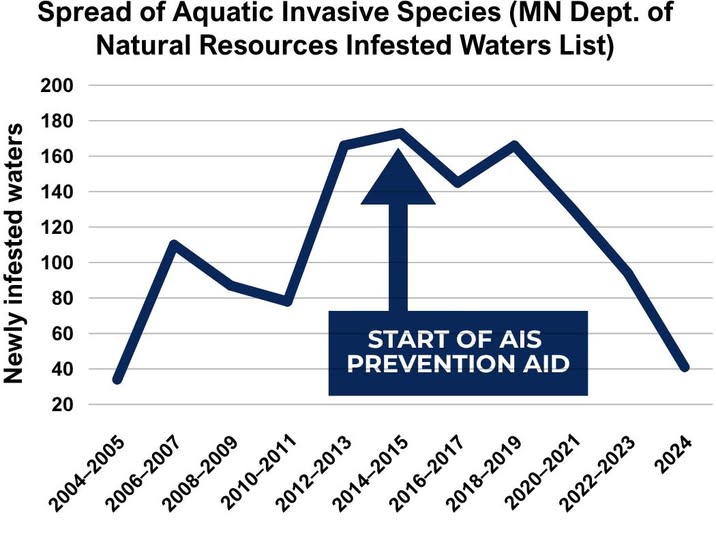
Many AIS experts note that Minnesota’s county-led programs have “bent the curve” for aquatic invasive species. Prior to 2015, the rate of infestations was growing rapidly, with as many as 170 new lakes being impacted every year. After counties rolled out their prevention efforts, that rate began to fall and we are now seeing closer to 40 new infestations each year. Though the challenge remains daunting, the Minnesota DNR notes that only 5% of Minnesota lakes have zebra mussels currently. The vast majority of lakes in Minnesota are still zebra-mussel free and worthy of protecting.
Unfortunately, local partners will need to work a bit harder to maintain their momentum in the coming year. Statewide AIS prevention funding is falling from $10 million to $5 million, which means funding for counties will be cut in half as well. In Washington County, this translates into an annual budget decrease from $143,000 in 2026 to $72,000 in 2027.
For water lovers interested in learning more about AIS, there is an AIS Research and Management Showcase coming up on Wed., Oct. 28 (7:45am-5pm) at the University of Minnesota St. Paul Student Center. Join researchers, managers, and AIS professionals to learn about the latest research on mystery snails, native aquatic plant restoration, zebra mussel control, and more. Tickets are $50 and are available online until Fri., Oct. 16 at z.umn.edu/AIS2026.


